


Graphic Design in Melbourne for everything your brand touches
Graphic Design By Steve and the Team!
Graphic design in Melbourne usually gets bought one piece at a time. A flyer here, a sign there, business cards from whoever was cheapest that month. Each piece looks fine on its own. Side by side they look like five different businesses.
I work the other way around. Every piece of graphic design Melbourne businesses buy here comes out of one brand system, so the pull-up banner, the membership pricing board and the Instagram template are recognisably the same business at a glance.
I am a designer, not a printer. I build the artwork, set it up correctly for the process it is going on, and hand print ready files to your printer, signwriter or packaging supplier. You own the files.
The studio is Steve's Creative Space, founded and led by Stefan Arambasic, with more than ten years of experience and more than twenty health and fitness businesses branded across Melbourne. The graphic design my Melbourne clients buy sits inside a brand package from $3,500, so you can see the cost before you enquire rather than after.
Design is not printing, and the difference costs you money
A printer prints exactly what you send. That is the job. They are not there to tell you the logo is stretched, the blue is not your blue, or the phone number sits 2mm from the trim line and is about to be guillotined off.
A designer decides what should be sent in the first place. That is where graphic design Melbourne businesses save money or waste it.
Here is what piecemeal design looks like after two years. The colour drifts, because one supplier built the brand blue in CMYK, another matched it by eye off a screen and the sign company used the closest vinyl in stock. Four versions of the logo are now in circulation, none of them the original. The flyer does not look related to the sign, and the sign does not look related to the uniform.
Nobody notices any one of those. Everybody notices the effect, which is that the business looks improvised. That costs more than the design ever did.
The fix is boring and it works. One master file set, one colour specification written down in every colour space, one set of logo lockups for different shapes and backgrounds, and every new piece built from those rather than a copy of the last job. That system starts with logo design in Melbourne and extends outwards into every surface below.
What gets designed
Most businesses need fewer pieces than they think, but they need them to agree with each other. A sign, a business card and a social post made six months apart by three different suppliers is how a brand ends up looking almost right and never quite the same twice. Below is the range of graphic design Melbourne clients ask me for. You will not need all of it, and I will say what to skip.
If you do not have a colour palette, type system and logo suite in place, collateral is the second job. The first is a complete brand identity, because without it every piece below gets designed from scratch and the drift starts again. That is also where most of the cost hides, in paying twice: once to make something, and again to make it match.

Stationery and practice essentials
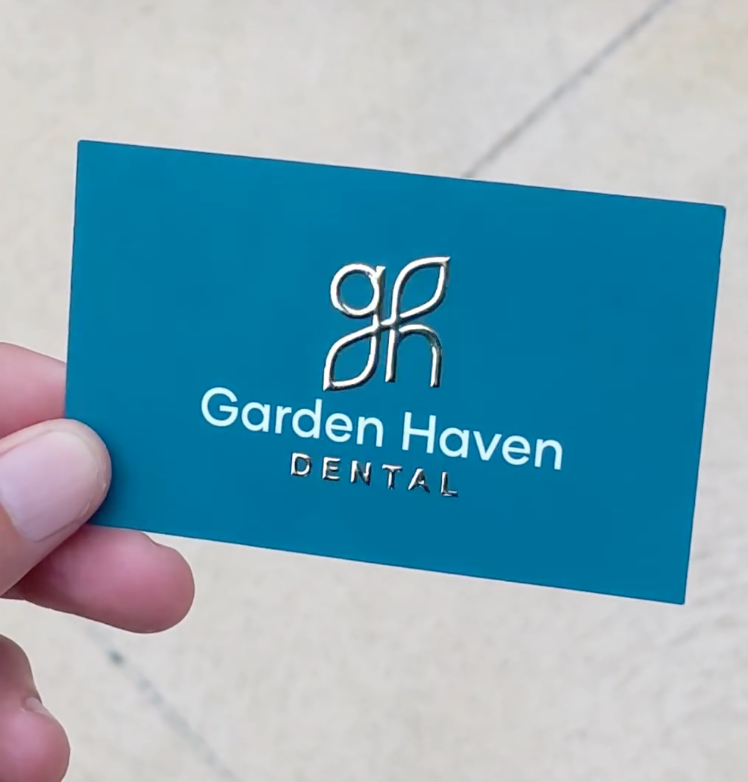
The pieces that go in a hand or in the post. Business cards, letterhead, with compliments slips, envelopes, appointment cards, referral pads, invoice templates, presentation folders, capability statements.

Print collateral and marketing material
Flyers, DL and A5 handouts, brochures and booklets, price lists, menus, service and treatment guides, posters, catalogues, annual reports, direct mail, membership and onboarding packs, point-of-sale cards.
Signage, window graphics and wayfinding
Fascia and exterior signage artwork, reception and feature wall graphics, window decals and frosted privacy film, A-frames, pull-up and teardrop banners, fence mesh, wayfinding, safety signage, vehicle wraps and door decals.

Packaging and labels
Product labels, swing tags, outer cartons, sleeves, pouches, mailers, stickers and seals, insert cards, shelf and display material.
Apparel, uniforms and merchandise
Uniform and polo artwork, activewear and tee prints, hoodies, caps, towels, drink bottles, tote bags, name badges, event and challenge merchandise.
Digital and social
Social post and story templates, profile and cover artwork, EDM and newsletter layouts, email signatures, online banners, PDF programmes and guides, presentation decks, landing page graphics, simple motion graphics.

What your kind of business actually needs printed
Generic collateral lists are written by people who have never stood in a gym at 6am or waited in a clinic reception. The pieces below get used, because they match the real surfaces of the business.
Gyms and fitness studios
Class timetables that stay readable when they are updated every term. Membership and pricing boards, usually the most looked-at print pieces in the building and usually the worst designed. Wall graphics and feature walls. Wayfinding for change rooms, studios and the functional area. Challenge and transformation campaign kits, meaning a poster, a sign-up form, a social set and a results template that match. Equipment and safety signage. Apparel artwork for staff and members. Window decals that sell from the footpath.
Physiotherapy, osteopathy and allied health clinics
Appointment cards, referral pads and GP referral letterhead. Exercise and rehabilitation handouts patients can follow at home. Treatment room and corridor signage. Practice management templates, so booking confirmations, reminders and recalls look like the clinic rather than the software. Waiting room material, including service boards, health fund information and new patient intake forms.
Dental practices
Patient information sheets, treatment and payment plan explainers, appointment and recall cards, consent and intake forms, reception and exterior signage. Anything patient-facing for dental practices working under Ahpra rules must be written and designed inside the advertising rules from the start, not edited afterwards.
Personal trainers and online coaches
Programme documents and training PDFs that survive being read on a phone between sets. Social templates you can update yourself without breaking the layout. Sub-brand kits, so a coach working under a gym's roof has a mark that sits alongside the venue instead of fighting it. Before-and-after templates built to stay consistent and compliant rather than rebuilt each time.
Health and wellness product brands
Labels for bottles, tubs, sachets and pouches. Swing tags. Outer cartons and shipper artwork. Shelf and display material. Compliance panels, including ingredient and nutrition information, barcodes and country-of-origin marks, laid out so the legal content is legible without swallowing the design.

What good looks like on each surface
Every format has its own rules. Here is what separates professional graphic design Melbourne businesses can rely on from a cheap job.
Business card. A cheap card is full. A good one is mostly empty. One clear hierarchy, name first, then role, then the one or two contact details that matter. Generous margins, because the eye reads confidence in white space. Heavy stock, because weight is the first thing a hand judges.
Brochure. The cover has one job, which is to make someone open it. Inside, the grid holds across every spread so the reader learns where to look. Body type at a size an older patient can read comfortably. Images shot for the layout, not cropped desperately to fit it.
Pull-up banner. Almost every banner fails the same way. The critical information sits in the bottom third, hidden by a table, a queue or a person standing in front of it. The top two thirds should carry the message and the logo, sized to read from five to ten metres, with contrast enough to survive fluorescent light.
Window decal. A decal is read from across the road, at an angle, by someone walking or driving. That means very few words, one dominant element, and a mark that still reads when half of it is behind a parked car. Frosted film has to work as a shape, because fine detail disappears at two metres.
Uniform. Embroidery cannot hold fine detail. Thin lines, small text and tight letter spacing fill in and turn to mush after a few washes. A good uniform mark is a simplified one or two colour version of the logo, spaced for thread, with a separate print version for tees.
Label. Labels compete on a shelf against neighbours you did not choose. The brand block needs to read at arm's length, the variant at half a metre, and the legal panel up close without dominating. Curved surfaces distort artwork, so the centre of a label is prime and the edges are not.
How the work runs
Four stages, the same every time.
01
Discovery call
Thirty to forty-five minutes, no charge. You tell me what you need made and where it is going. I tell you what is missing, what you can skip, and whether this is a collateral job or a brand job. You get a written scope and price before anything starts.
02
Strategy
Short for a collateral project, longer if the brand system does not exist yet. We agree the colour specification, type system, logo lockups and the list of pieces. You supply copy, photography, sizes, printer specifications and dielines. Missing copy is the main cause of a stalled job, so I will chase it.
03
Design
First concepts on a single piece, then the system rolls out across the rest once the direction is signed off. As a working guide, a single piece with an existing brand system is usually 3 to 5 working days to first concept and 5 to 10 working days to print ready artwork. Inside a package, Foundation is delivered in four weeks and Transform in five to eight weeks.
04
Launch and handover
I supply print ready PDFs built to your printer's specification, plus editable source files and web versions. If you want, I deal with the printer or signwriter directly, check the proof and sign off on colour before the run. The Steve's Creative Space Brand Confidence Guarantee covers the start of the project: if the strategy session does not feel right, your deposit comes back in full.
Frequently asked questions
-
It ranges from about $50 for a marketplace template to several thousand for studio work, and most studios publish nothing. Productised sellers generally sit between $299 and $1,299. At Steve's Creative Space, collateral design sits inside brand packages starting from $3,500, with pricing published on the services page. Printing, signage manufacture and packaging production are paid to your supplier separately.
-
No. I design and supply print ready artwork, then your printer, signwriter or packaging supplier produces it. That keeps you in control of production cost and lets you use a supplier local to you. If you would like, I will deal with them directly, build the files to their exact specification, check the proof and sign off on colour before the run begins.
-
Because print and screen build colour in completely different ways. A monitor emits light and mixes red, green and blue. A press lays down the same four process inks every time, cyan, magenta, yellow and black, as fine dot screens, and how those dots sit on the page depends on press calibration, dot gain and the stock, so the same file shifts slightly between presses and between coated and uncoated paper. Bright blues, greens and oranges are the worst offenders, because process ink cannot reach them and they print noticeably duller. You receive your colours specified in CMYK for print, HEX for web and RGB for screen, so every supplier works from a written value instead of matching by eye.
-
A press ready PDF at the final trim size, with bleed and crop marks, colours in CMYK, fonts embedded or outlined, and images at 300DPI at their used size. Word documents, PowerPoint files, screenshots and phone photos are not print ready, and sending them is one of the most common causes of a reprint.
-
For a single piece where a brand system already exists, allow roughly three to five working days to first concept and five to ten working days to print ready artwork. A full collateral suite takes weeks rather than days. Where design is delivered as part of a package, Foundation is delivered in four weeks and Transform in five to eight weeks. Slow copy approvals are the usual delay.
-
Yes. If you have a guidelines document, logo suite and colour specification, I design inside them and the job is faster and cheaper. If the guidelines are thin or the files have drifted into several versions, I will tell you what needs tightening before the collateral is built, so the new work does not inherit the old inconsistency.
-
Yes. Labels, swing tags, cartons, pouches, sleeves and shelf material, built onto the dieline supplied by your packaging manufacturer. That includes barcode placement, ingredient and compliance panels, and substrate considerations. Where a brand has several products, I design the range as a system so variants are distinguishable on a shelf while the brand block stays constant.
-
300DPI at the size the image is actually printed. A 72DPI web image has nowhere near enough data and will look soft or blocky, and enlarging it cannot add detail that was never captured. Vector artwork, such as a properly built logo, has no resolution limit and stays sharp at any size. Large format signage is the exception and is supplied lower on purpose.
-
Yes. I am Melbourne based and work with clients throughout Australia. Design work is file-based, proofs are reviewed on screen, and your printer or signwriter is local to you, so distance makes very little difference. For signage or a fit-out I will visit anywhere in Melbourne, or work from measurements and photographs supplied by your installer interstate.
-
One-off pieces are possible for existing clients whose brand system I already hold, because the system makes them quick and consistent. For new clients I do not recommend it. Designing pieces individually without an agreed colour specification, type system and logo suite is exactly what produces the mismatched collateral most businesses come to me to fix.

Ready to build a brand that performs?
Let’s create something bold, strategic to align with your business goals.